One Province, One Mission: A Network Ethos for Pre-Secondary and Secondary Education
What does it mean to be a Jesuit school in the USA East Province?
As we collectively discern the challenges and opportunities of our Apostolic Plan, Jesuits USA East is developing a shared ethos for secondary and pre-secondary education. This ethos is grounded in the conviction that our schools are not isolated institutions. They are apostolic works of the province, connected to one another and to the wider mission of the Society of Jesus. Our 29 secondary and pre-secondary schools are, in a real sense, one educational constellation—distinct communities, but part of something larger than themselves.
“Indeed!” agrees Dr. John Moran, new president at Cheverus High School in Portland, Maine. “I strongly believe that Cheverus, one of the smallest works in one of the more remote reaches of the province, survives—and thrives—because we so strongly embrace our connection with the wider Jesuit community.”
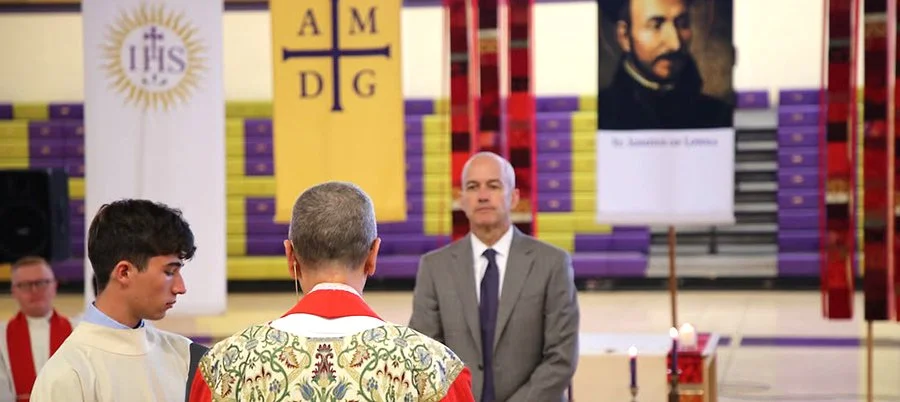
Dr. John Moran is commissioned the first lay president of Cheverus High School by Fr. Provincial Robert Reiser, SJ.
A healthy network begins with relationship. We want our schools to interact, to learn from one another, and to recognize that the successes and challenges of one school matter to the others. Through both our own province network and the Jesuit Schools Network (JSN), gatherings, school visits, common initiatives, and opportunities for shared learning will cultivate trust and collegiality and better unite us to the mission of the Society and the Church.
It also means welcoming accountability as an expression of cura apostolica—the province's care for the apostolic works entrusted to it. Mission review, candid conversation, and accompaniment are not simply mechanisms of governance. They are ways of asking together: How well are we living the mission? What is God inviting us to do next? And how can we help our partner institutions?
Perhaps most importantly, this new ethos will place a renewed emphasis on formation for mission, particularly the formation of school leaders.
Jesuit education depends upon leaders who understand and advance the mission that make their schools uniquely Jesuit. Presidents, principals, board members, and colleagues need an ongoing grounding in Ignatian spirituality, Catholic mission, Jesuit education, discernment, and the Society's way of proceeding. The province's commitment to executive formation recognizes that leaders are not simply “formed” when they take office. They are part of an ongoing investment in their lives to build on the mission they carry forward. “This formation needs to begin early in the Jesuit educator’s career,” adds Dr. Moran. “Much like the Jesuits themselves, it takes years to form an Ignatian educator and leader, and by the time one arrives in a complex position such as principal or president, there are too many demands on one’s time to begin the process.”
This is especially significant for schools where there may not be a Jesuit serving on staff. Through this network ethos, a school without a Jesuit on campus can indeed remain deeply Jesuit. The network will provide lay leaders and colleagues with opportunities to encounter the Spiritual Exercises and Ignatian spirituality, to understand the history and mission of the Society, and to develop the habits of discernment, reflection, accompaniment, and service that characterize an Ignatian presence. Jesuit identity is sustained by those who are continually formed to carry the mission.
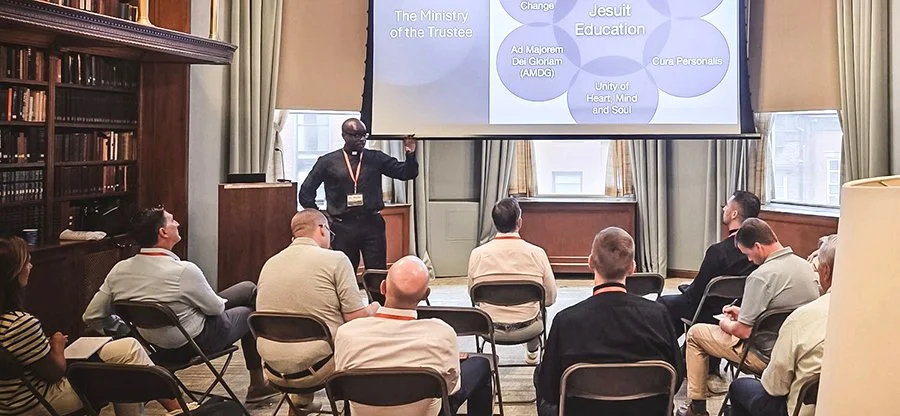
Fr. Mario Powell, SJ, speaks at a launch event for the new Pathways to Formation: Trustee Formation Program.
Ultimately, a healthy province-wide ethos depends upon schools that are willing to participate beyond themselves, welcome relationship and accountability, invest continually in people for mission, and discern local priorities in light of the common good. The goal is not simply a network of well-managed schools, but a network of schools deeply connected to one another and united in a shared mission.
As Fr. Mario Powell, SJ, provincial assistant for pre-secondary and secondary education, aptly sums up, “We are 29 schools; one province; with one mission.”